Staff

Tuesday, August 27, 2013

Course Conditions; Approaching Fall

Weather:
Despite the current weeks forecast, weather patterns seem to be heading in a Fall-like direction as we approach the month of September.  Temperatures peaked in late July, directly after a heavy rain of 1.6".  Milder conditions followed and damaged areas of fairways were able to recover.  The week of the Men's Invitational saw some of the best weather we've experienced for the event in years, rarely has the course been that green in early August. 

Greens:
Poa annua is a notoriously shallow rooting plant and because of that minimal root system the top 2" of the soil profile need to stay relatively moist.  Automated sprinklers and irrigation systems are great tools but do not provide the accuracy that hand watering does.  Members have probably noticed crew members watering the greens on a consistent basis to keep the rootzone moist and the plants alive.  While the amount of water being applied is usually light, it still has a negative effect on green speed.  In comparison, creeping bentgrass roots extensively, and repeated irrigation isn't as necessary.  Other practices can be changed to raise the speed of the greens (i.e. lower height of cut, aggressive rolling) but to perform these in the middle of the season is just asking to lose grass, with the plant already being in a precarious state.  However, certain events require fast greens and for the Club Championship the crew was very conservative with it's watering and very liberal with it's rolling, resulting in green speeds of 12 feet or more.  The point being that it is possible to push poa greens into the higher speeds (12 or up) for periods of time, but maintaining those speeds throughout a typical season is agronomically unsound. 
The dark green irregularly shaped ring on the putting surfaces is the work of a variety of fungus that result in the disease Fairy Ring.  Localized Dry Spot, a typical companion of Fairy Ring has been observed as well (the off-color wilted sections within the Fairy Ring) raising the necessity for watering.  A fungicide application has been made to control the disease but keeping the moisture and fertility at an an adequate level is necessary for recovery. 

Tree Care:
On the 26th, two arborist performed structural evaluations on four black walnuts (on the 9th green, behind the 18th green and two near the 15th green).  A special tool is utilized that measures the resistance as it drills through key structural points on the tree.  These key points are obviously the trunk but other large limbs that present a hazard are measured as well.  If the trees do not posses the necessary structural integrity than they have to be removed.  Removal of chemically damaged trees will continue as planned when the weather turns favorable for hard manual labor. 

Fall Projects:
A rise in "fried egg lies" has prompted the need to amend the bunker sand.  A ball lie rating scale set forth by the USGA recommends bunker sand have a rating of 2.5 kg/cm2 or higher.  As it stands now, with no amendments, MCC bunker sand has a rating of 1.6.  The sand to be utilized, Pro-Angle, when mixed with our current sand provides a ball lie rating of 2.5.  Two inches of Pro-Angle will be mixed into all the green side bunkers. This will be a time consuming (and somewhat back-breaking) process but the crew hopes to tackle a hole a day while still tending to the other needs of the course. 

Tuesday, August 6, 2013

2013 Men's Invitational

Welcome to Meadowbrook Country Club and the 2013 Men's Invitational!
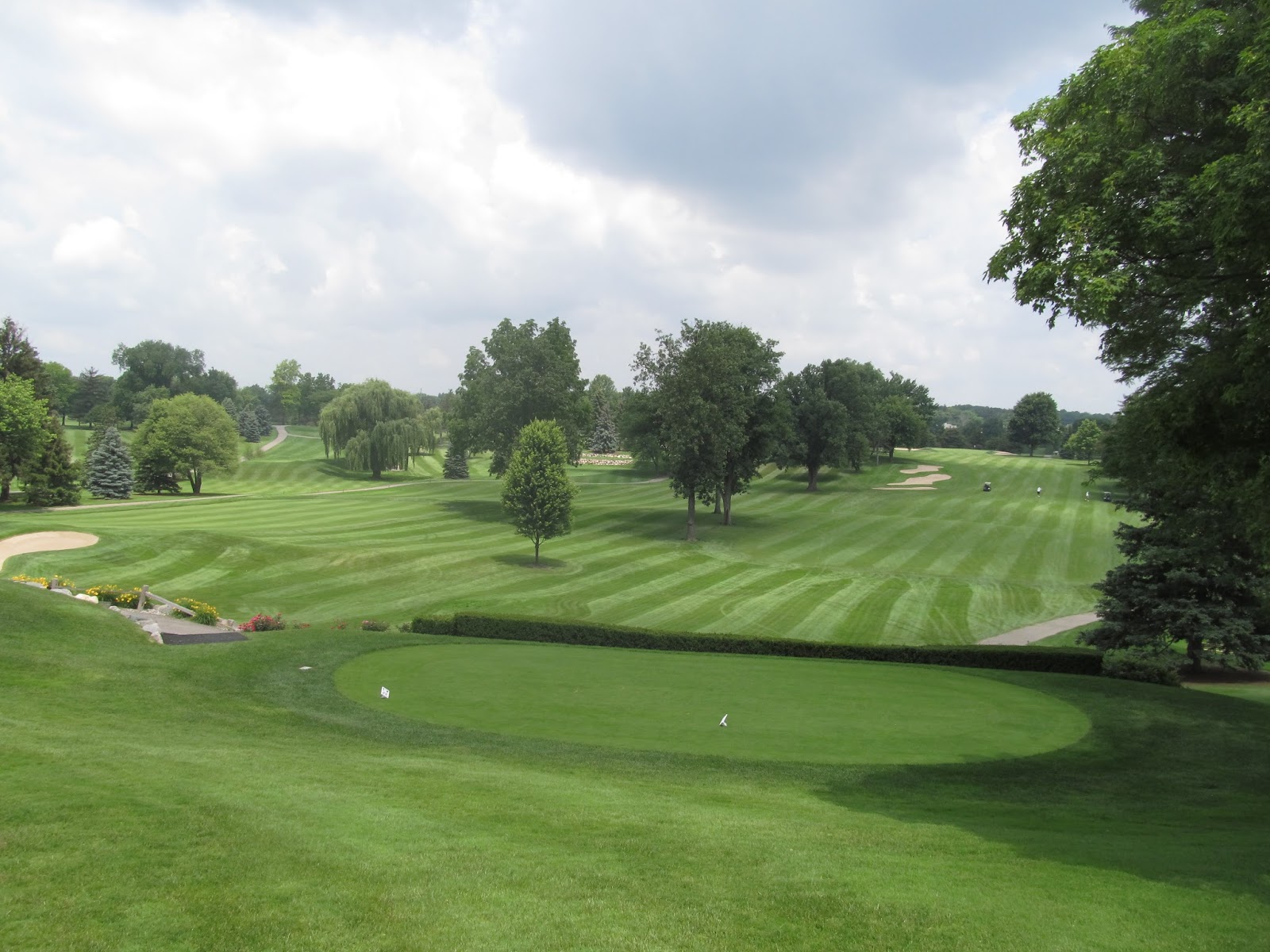
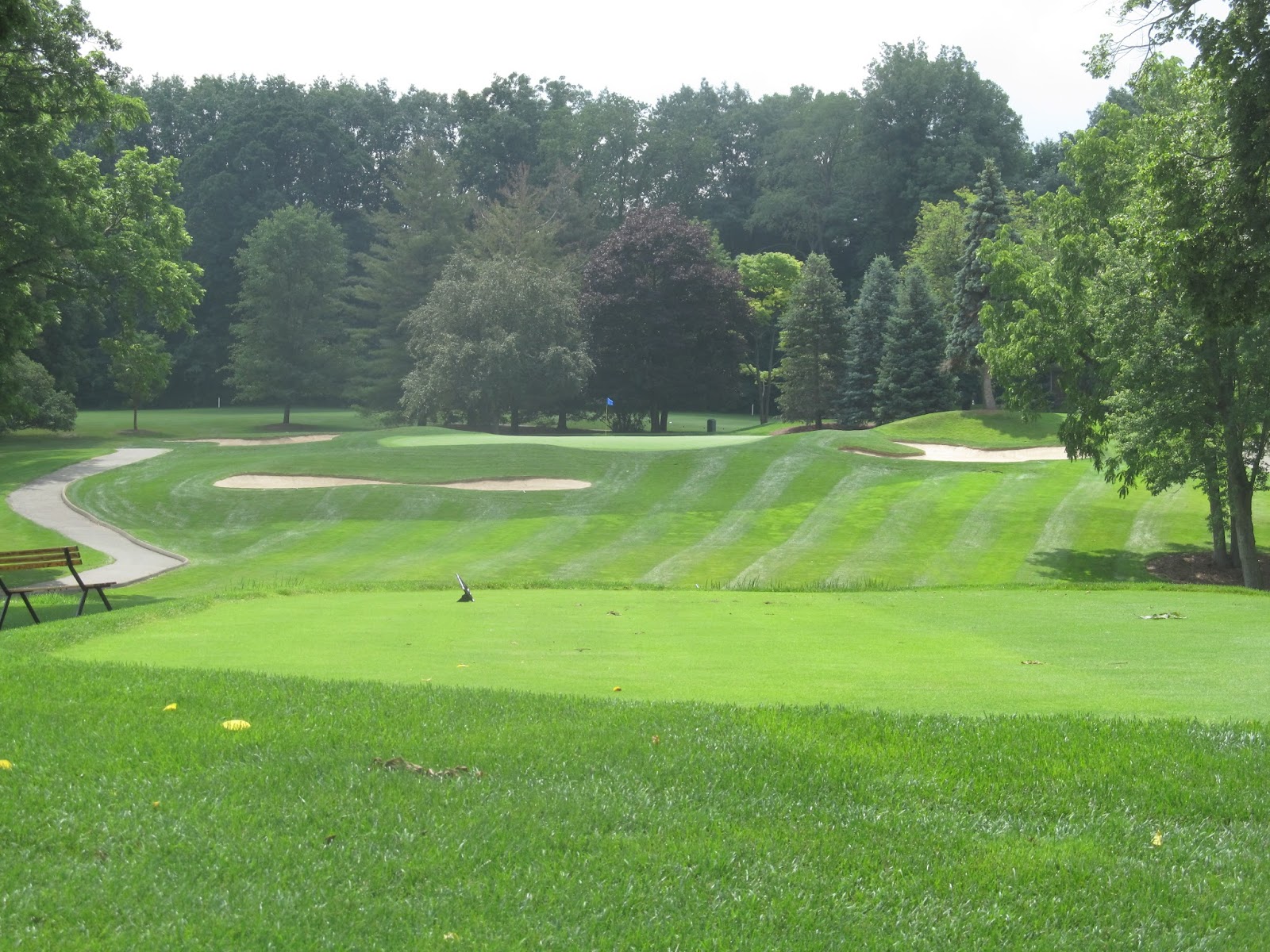
The staff has worked hard all summer  and we are proud to present the finished product. The original 6 holes of MCC were designed by Willie Park Jr. and in order to honor his commitment to the game of golf, the winners will be awarded a sculpture of his likeness. Over 125 acres are here for your enjoyment so respect the smooth greens, take in the beautiful views, and as always, remember to stay pin high.

Willie Park Jr. (1864-1925)
 

Tuesday, July 16, 2013

A Tip of the Hat

At 6pm, on Monday the 15th, Meadowbrook received a whopping 1.25" in a 30 minute span.  Periodic rains through the rest of the night brought the total rainfall to the Northville area up to 1.7".  July has already been a wet month, with the total precipitation recorded by the MCC weather station at just under 3".  90 degree weather and high humidity has also set in, skyrocketing disease pressure and increasing the chances of losing grass in completely saturated areas (we're looking at you, bottom of 12 fairway).  The following are some of the tasks that the crew will complete today to keep the course playable and the turf alive:
  • Repairing Bunkers- During a heavy rainfall, bunker sand on the flashings and sides will wash down into the middle of the hazard.  The only solution for this is manually shoveling or pushing the sand back on to the sides.  With the heat and humidity, this already labor intensive process becomes even more unpleasant. 
  • Removing Standing Water- Water remaining on the surface can suffocate turf if left unchecked.  These saturated soil conditions can also lead to infection by two of the most devastating fungal diseases; Pythium and Anthracnose.  The crew will use multiple tactics to be rid of this water such as pumps, probing for drainage lines (gives the water a clear path to the drainage line and off the surface) and roller squeegees.  The crew member assigned to this job rarely escapes with dry feet. 
  • Needle Tining Greens- Because of the saturated conditions, black layer has been observed on the putter.  Black layer, as the name suggests, is a layer through the rootzone that has stayed saturated for an extended period of time.  Aerobic respiration byproducts include carbon dioxide and water.  However, without the presence of oxygen, the anaerobic bacteria that inhabit this layer produce hydrogen sulfide (H2S as opposed to H20).  Hydrogen sulfide is a toxin more poisonous than hydrogen cyanide and is thought to be an attributing factor to the decline of turf in the area.  Also, black layer prevents the percolation of water through the rootzone, leaving greens soft and slow.  Needle tining (smaller aerification holes) is utilized to reintroduce oxygen back into this layer, hopefully decreasing the amount of sulfur reduction in the soil (sulfur reducing bacteria are extremely sensitive to even trace amounts of oxygen).  To be on the safe side, the crew will perform this practice to all the greens. 
  • Walk Mowing Greens- While this is done everyday it becomes even more important when conditions are soft.  The lightweight mowers minimize the chances of scalping the greens.  The only reason it is mentioned now is that the average green set requires the crew member to walk about 4 miles...in already 80 degree heat and 80% humidity. 
  • Additional Spray Applications- Because of the increase in disease pressure, an additional spray application will be made on greens to combat the conditions. 
A tip of the hat to the crew is in order.  Battling heat, humidity and play, the crew has kept the course playable and in good shape.  We encourage the members to play but stay hydrated and use caution when carts are again allowed on the course.  Enjoy. 

Monday, July 15, 2013

Mavis Consulting; Topdressing Study

Over the past 3 years, Meadowbrook CC has participated in a topdressing study performed by Brian Mavis of Mavis Consulting.  The purpose of the study was to determine the amount of sand remaining after a topdressing application, the physical properties of that sand and the different means of working the sand into the rootzone. 
During a normal topdressing, sand is applied and than worked into the rootzone through the use of various methods including verti-cut units, drag brushes and irrigation.  When the greens are mowed the following day, the yield from the mowers usually have a certain amount of sand in the baskets that catch the clippings.  For the purposes of the study, the sand and grass clippings are separated after each mowing (members may have noticed the grass piles on cart paths) for 3 days after a topdressing event.  The collected sand is than tested to determine which particle denominations were not worked into the rootzone and the total amount collected over 3 days compared to the amount applied. 
How is this information relevant to members?  Previous articles have mentioned the benefits of topdressing but as a quick reminder, topdressing benefits include;
  • Surface Infiltration
  • Stability and Firmness
  • Smoothness of the Putting Surface
  • Green Speeds (not immediately but firmer greens usually are faster greens)
The more the crew knows about how the sand works in, which particles remain and acceptable rates of application, the more efficient they become in the application process.  The study has shown that an insignificant amount (<1%) remains on the green surface after a topdressing.  The physical properties of this sand show that the individual particles remaining are of the coarser variety (larger particles) and it makes senses that these are the hardest to work through the turf canopy.  While these particles are wanted in the rootzone, there is such a small amount of them collected that it can be assumed that the majority have worked their way into the greens.  As this study progresses, the best methods of application and rates can be determined, benefiting the members in terms of minimizing the disruption of the putting surfaces during season.  Enjoy. 

Thursday, June 27, 2013

Course Update; The Arrival of Summer

Weather:
Summer heat and spring rains have teamed up over the past two weeks, a combination that usually proves difficult for turf management.  Across metro-Detroit there have been reports of rain incidents in the 3"-5" range, amounts that definitely spell trouble for courses with poor drainage.  This being said, we can consider ourselves lucky at MCC.  The majority of the rains and heavy storms have missed the Northville area (knock on wood) and Meadowbrook's weather station has only recorded 1.6" since the start of these storms.  It's common to assume that turf professionals are happy when it rains.  This is rarely the case and most superintendents prefer a dry season as opposed to a wet one.  Amounts of .2" are desired, but only if it's spread out over a long period of time.  High humidity and heat are obviously concerns as well.  These conditions, coupled with saturated soils, skyrocket disease pressure.  Pythium is a devastating disease and infection becomes likely in conditions similar to the present. 

Greens:Despite the weather, the greens have held up reasonably well.  A new topdressing sand started being utilized 2 years ago and an approximate 1" of this new material has been incorporated into the rootzone.  This sand is coarser and each particle is angular in shape (an important physical property to ensure stability) which benefits infiltration from the surface and also retains the firmness of the green.  After a heavy precipitation event, better surface drainage and firmness has already been observed on greens. 
The new topdressing sand has improved the previously mentioned aspects of greens but can only do so much for green speed after it rains.  To ensure that the greens are still rolling at an acceptable level the crew walk mows and rolls the greens daily.  Rolling has even been increased to combat the wet/soft conditions. 
Members have probably noticed the bulls eye like rings and the small irregular shaped yellow rings on the putting surfaces.  These are the result of two diseases called Fairy Ring and Waitea.  Fairy Ring (the bulls eye like disease) appears as dark green circular shapes.  The darker green circle (or "zone of stimulation") is the result of the pathogen breaking down organic material and making nitrogen stored within the organic matter available to the plant.  This disease will only damage turf during periods of heat or drought stress on the margins of the zone of stimulation.  Waitea appears as the irregular shaped yellow rings on the greens.  Rarely is this disease deadly either, but it is a potent thatch decomposer as well.  This is significant because, if left unchecked, the disease can leave sunken rings on the greens resulting in bumpier putts.  Both of these diseases have limited chemical controls but, on the recommendations of the MSU turf team, the crew has made a fungicide application that is expected to check the infections. 

Around the Course:
High heat, humidity and heavy rains are particularly worrisome for superintendents in regards to their fairways (mentioned in the weather section).  The majority of fairways in southeastern Michigan are not compromised of soils that drain well, namely silts and clays.  Besides the increase in disease pressure, saturated conditions themselves can lead to turf death.  If the rootzone stays saturated, aerobic respiration within the cells of the roots stops.  The plants begin to rely on anaerobic respiration which is extremely inefficient as compared to when oxygen is available.  The turf turns chlorotic (a general yellowing of the leaf blades) as more and more of the root cells die off.  Small, localized spots of this chlorosis are being observed on certain areas of fairways at MCC even with the relatively small amount of rain.  To combat these conditions, the crew aerifies these areas to open up channels for air exchange.  Recovery of aerification holes at this point in the summer is very slow so a smaller tine is utilized to expedite the healing process. 
The 14th and 15th tee perennial beds have been redone, as they were in a state of decline from an aesthetic standpoint.  The new species in these beds include:
  • Knockout Roses (Yellow)
  • Thyme
  • Joe Pye Weed
  • Variegated Japaneses Silver Grass
  • Cranes Bill Geranium
  • Japaneses Forest Grass
  • Sedum Ground Cover 

The new Kentucky Bluegrass sod around green complexes was thriving during the month of May and early June.  The crew was hard pressed to keep up with the mowing demands of the grass in these areas but due to the higher temperatures, growth has slowed down.  The dense sod, maintained at a 2" height of cut, is aesthetically pleasing and provides a consistent lie around all the greens.  Prior to sodding, a multitude of different species surrounded the greens and golfers never knew what type of lie they were going to get. 

Tree Care:
Tree care is an on-going task for the crew year round.  During the summer, members will most likely see sprinklers running in the large evergreen beds to negate any possibility of drought conditions.  These chemically damaged trees need to suffer minimal stress in order for them to recover (if recovery is even possible).  Removals are continuing too, and some have significantly changed the look of certain areas.  In particular, the 17th green was surrounded by spruce and pine trees that suffered the brunt of Imprelis and 6 trees were removed from the area.  These removals opened up the 17th green for great views around the course. 

The previous 3 summers have brought extreme weather conditions, ones that do not make it particularly easy to maintain turf.  The summer of 2013 has proven to be mild, until recently, and the crew hopes this isn't a trend for the rest of the season.  During these wet and soft conditions we ask the members to be mindful of where they drive carts as compaction of soils can occur quickly when saturated.  Other than that, stay pin high and enjoy. 

Tuesday, June 11, 2013

Tree Inventory and Assessment

Last fall, Meadowbrook CC requested and completed a tree inventory of all the trees located on the golf course, club grounds and range.  The total came to 1,467 and each of these were documented in regards to  species, size, condition and recommendations for future care. As members are aware, MCC boasts some truly amazing specimens, for example the black walnut on the 15th fairway, the towering shagbark hickory  behind the 5th green, the oak trees near the 4th hole and a couple remaining elms scattered throughout the course, to name a few. 


The real value of the tree inventory is that it lays out a road map of tree care over the next several years.  With each tree inspected for everything from disease to structural integrity,  the instructions are there to make the tree population truly shine.  The following is a generalized list of some of the issues/cultural practices that the arborist inspected each tree for, issues that homeowners should be aware of as well if they have good specimens or young trees within their property.
  • Co-dominant Trunks- 2 leading trunks compromise the integrity of the tree and is rarely pleasing from aesthetic standpoint.  If the tree is mature not much can be done, but young trees with co-dominant headers can be pruned to select the better of the two. 
  • Girdling Roots- This refers to roots that are strangling portions of the tree, especially in situations when mulch has been piled too high around the base of the trunk.  Some of these are visible, but they can occur underground as well.  Root girdling is suspected if specific portions of the tree are in decline while the rest appears healthy.  Maple trees are susceptible to girdling roots. 
  • Pruning- This refers to a multitude of practices including removal of deadwood, thinning and crown cleaning.  A large number of trees at MCC are going to or presently require pruning so the crew will be kept busy.  
  • Disease/Pests- There a variety of diseases and pests that can infest any given species.  To name only a few, the crew has treated evergreens for needlecast (fungal pathogen), Diplodia (fungal pathogen) and the white pine weevil.  Flowering crab apples require fungicide applications for apple scab, while Linden Trees and Roses are susceptible to adult Japanese Beetles and need an insecticide to prevent damage.  
  • Structural Integrity- If weakened structure is suspected, a structural evaluation of the tree is a good idea.  This will make the property owner aware of any possible hazards in the future.  The black walnut by the 9th green is a good candidate for a structural evaluation due to its odd branching and heavy fruit that can weight down limbs.
  • Removals- An easy solution but one that is not made lightly.  Usually a result from one or a combination of the above issues, these trees present a current or potential danger to important aspects of the course or golfer safety. 
    9th Green Walnut Tree; A good candidate for a structural evaluation
The tree population as a whole was scrutinized as well, especially in terms of diversity.  A group of arborist recommend the following diversification guidelines (referring to the taxonomic hierarchy i.e. Kingdom, Phylum, Class, Order, Family, Genus, Species):
  • No more than 30% of the same Family
  • No more than 20% of the same Genus
  • No more than 10% of the same Species
The pine Family, encompassing most of the evergreens on the course, is over the 30% guideline recommended.  Part of this is due to the large, protective blue spruce plantings alongside the driving range but there is a significant percentage of evergreens on the course as well.  The chemical Imprelis highlighted this lack of diversity.  The majority of pines and spruces on the course were damaged by the herbicide, and if removals are necessary, the diversification of the population will suffer too.  To even the population out, when a new planting is necessary, a different species is utilized.  Concolor firs and limber pines are beautiful trees that have similar environmental requirements as blue spruces and white pines, making them suitable replacement trees. 

In conclusion, the tree inventory and assessment could not have come at a better time.  Because of DuPont's chemical debacle, the tree population is in a precarious state, and one that will have to be monitored closely.  With this new tool, the staff will be able to not only navigate this uncharted territory but improve on the quality and health of the other trees on the property. 


Monday, June 3, 2013

No-Play Mondays

The crew had an open course on the 3rd of June and took full advantage of it.  Scrambles are an excellent source of income but when the occasional free Monday occurs, the staff can complete a multitude of tasks that normally would be impeded by golfers.  The following is a list of tasks completed today.  Enjoy the course tomorrow (Tuesday, the 4th).

  1. Topdressed Greens, Tees and Aprons- With optimum growth temperatures for turf, topdressing becomes even more important in terms of diluting thatch build-up. Topdressing involves the following, all of which were performed on Monday.
    1. Verti-Cut- disc like blades bring up thatch and open up channels for sand to work in to.
    2. Dragging- a tow behind brush is utilized to work the sand into the profile
    3. Watered Greens- using the automatic sprinklers also helps to work sand into the greens profile.
    4. Rolled Greens- to smooth the surface after so many disruptive tasks have been performed on the greens
    5. Sprayed Greens- Specialty fungicides, fertilizers and plant growth regulators are applied to speed recovery and improve general green health.
  2. Fairway Spray Application- With the turf literally jumping out of the ground, a heavier rate of plant growth regulators were applied to slow the growth.  
  3. Large Mulch Beds Sprayed with Herbicide- The numerous large mulch beds have all now been sprayed with a combination Round-Up and Surflan, to control existing weeds and prevent future ones.
  4. Green & Tee Banks Fertilized- A SLOW release fertilizer was applied to the banks to keep them well supplied with nutrients throughout the summer.  This product also holds an insecticide that will control root-eating grubs in these frequently played areas.
  5. Edged Bunkers- To maintain a crisp, manicured look around the bunkers with the current growth explosion, a team of staff members edged all 60+ bunkers on the course.
  6. Driving Range Tee- An extensive amount of work was performed on the driving range tee including...
    1. Mowing and Weed Whipping
    2. Topdressing old hitting stands
    3. Seeding old hitting stands
    4. Cleaning Flag Yardage Markers
    5. Painting Fixed Light Poles
  7. Sprayed Austrian, Scotch & Red Pines-  Diplodia is a common, destructive disease on these pine species, a genus that has already been hard hit here at MCC.  A fungicide application was made to prevent further decline.  
  8. Mowed Rough- +60 Acres of rough were mowed today so hopefully not as many balls will be lost this week.  
  9. Cleaned Sprinkler Heads- While a mundane, tedious task, an important one to keep sprinkler shells free of debris and marked yardages visible.  
  10. Mowed/Weed Whipped Clubgrounds
  11. Mowed Tee & Green Banks
  12. Changed Cups in preparation for the following morning.